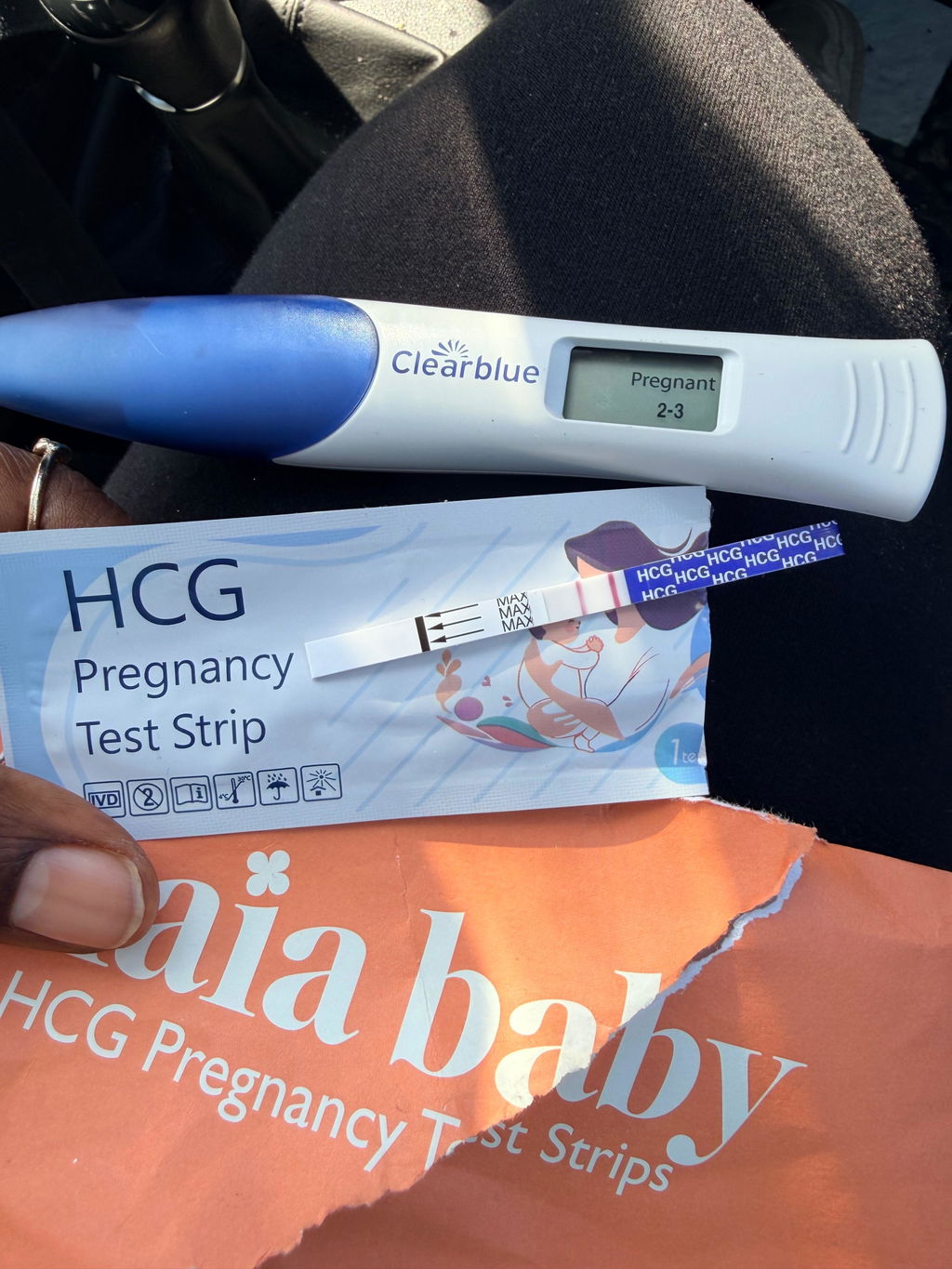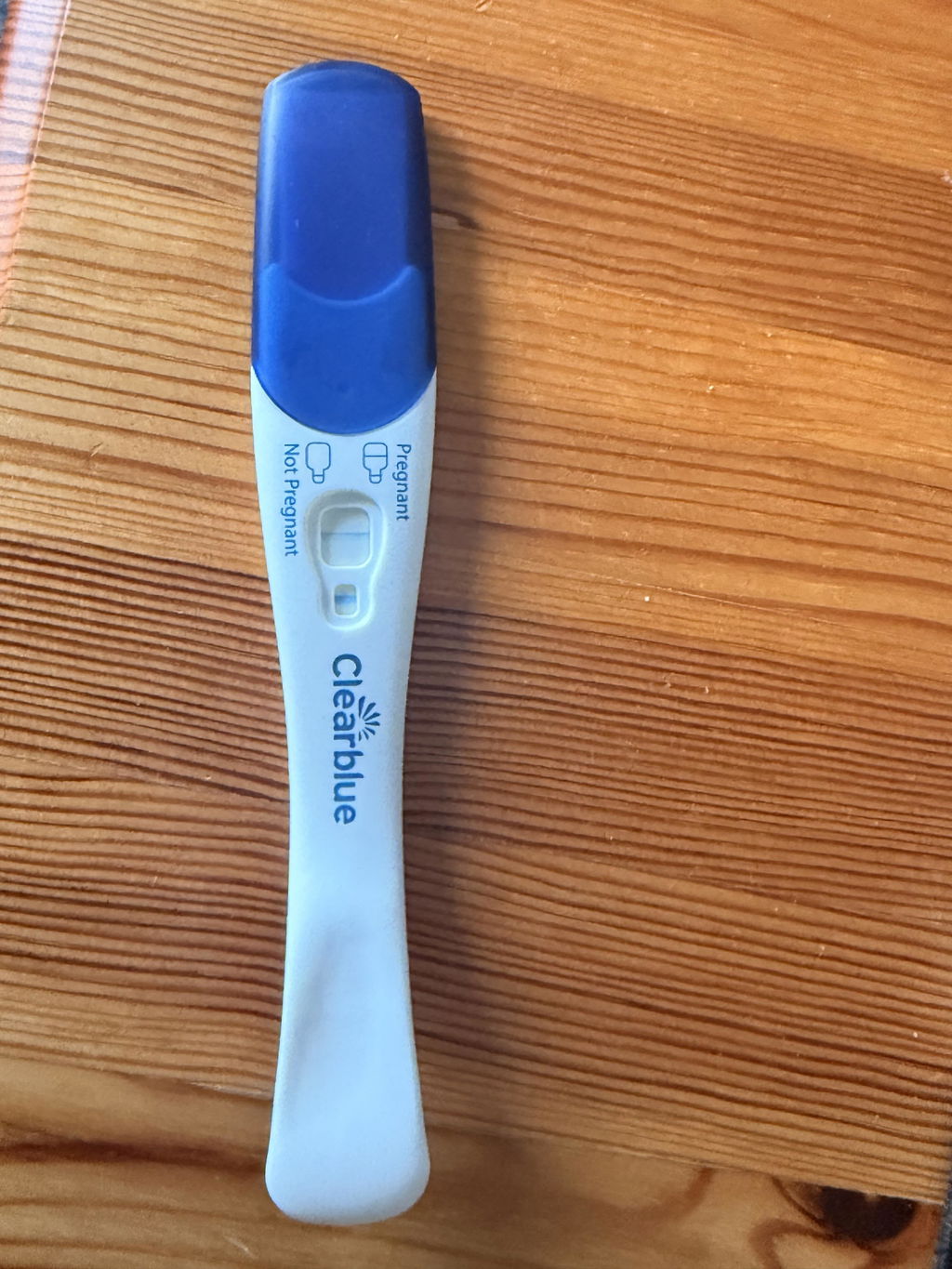


A faint line. A few days of hope, of quietly working out a due date. Then the line fades, the next test is negative, and a bleed arrives. If that is where you are today, I am so sorry.
A chemical pregnancy (also called a biochemical pregnancy) is a very early miscarriage, usually by 5 weeks. A test picks up the pregnancy hormone hCG, but the pregnancy ends before it could be seen on a scan. The usual signs are a positive test that fades to negative and a bleed like a period. No treatment is normally needed, and you can try again when you feel ready, once your symptoms have gone. That is how Tommy's and Miscarriage UK (formerly the Miscarriage Association) describe it, and the advice on trying again is the NHS's.
Two things before anything else. It was a real pregnancy, and it is a real loss. And as Tommy's puts it, in almost all cases it will have nothing to do with anything you did. The most common cause is thought to be a chance chromosomal problem in the embryo. Testing early did not cause it either.
If you want to talk to someone today: the Tommy's midwife helpline is 0800 0147 800 (free, Monday to Friday, 9am to 5pm), and the Miscarriage UK support line is 0303 003 6464. The full list is near the end of this page.
If you have severe tummy pain, pain in your shoulder, you feel faint or dizzy, or the bleeding is heavy, call 999. The full warning signs are further down this page.
What is a chemical pregnancy?
A chemical pregnancy is a very early miscarriage that usually happens by 5 weeks of pregnancy, before anything could be seen on an ultrasound scan. Tommy's describes it like this: "A pregnancy test detects an increase in pregnancy hormones, but the embryo is lost before it can be seen on an ultrasound scan."
The word "chemical" describes how the pregnancy was found: through the hormone hCG in your urine or blood, not on a scan.
It was almost certainly not a false positive. Your body starts to make hCG around 6 days after fertilisation, and the NHS says a positive test result is almost certainly correct.
Some people find the phrase itself upsetting, and I guess that is because "chemical" can sound as if it was never a pregnancy at all. It was. Use whatever words feel right to you: early miscarriage, early loss, or none of them.

What are the signs of a chemical pregnancy, and how long does it last?
The main signs of a chemical pregnancy are a positive pregnancy test that turns negative soon after, mild cramping, and a bleed like a period, and it is usually over by around 5 weeks. Between them, Tommy's and Miscarriage UK list these:
- A positive test, then a negative one soon after. The positive is often a faint line.
- Mild cramping.
- A bleed like a period, even after a positive test. Miscarriage UK says it may feel heavier or more painful than normal, and you may pass some small blood clots.
- Spotting a week before your period is due.
- Low hCG on a blood test, if you have had one. If you are having fertility treatment and your hCG is being tracked, you may see it rise and then fall.
- Sometimes no symptoms at all beyond the test result itself.
If you are looking at a test and wondering whether the faint line was ever really there, our guide to evap lines and faint positives explains how to tell the two apart.
The bleed usually comes around the time your period was due, and is usually similar to a normal period. After a miscarriage, the NHS says it can take up to 8 weeks before you have a period again, and a few months for periods to go back to what is usual for you. Tommy's says you may ovulate before that period. If it has not come back by 8 weeks, or you are worried, contact your GP.
One caution. A faint or slow positive with bleeding can also be an ectopic pregnancy, which is why the next section matters.
When should you get medical help?
Call 999 if you are pregnant, you are bleeding, and you have severe tummy pain, shoulder pain, faintness or heavy bleeding. A chemical pregnancy does not usually need treatment, but the NHS is clear about the signs that do.
Call 999 if you are pregnant, have vaginal bleeding and:
- severe pain in your tummy (you cannot do daily tasks or focus because of the pain)
- pain in your shoulder
- you feel sick, faint or dizzy, or you lose consciousness
- the bleeding is heavy (soaking a period pad soon after putting it on)
An ectopic pregnancy can look like a chemical pregnancy. Around 1 in every 90 UK pregnancies is ectopic, about 11,000 a year, according to the NHS ectopic pregnancy guidance. The NHS notes that some women mistake the bleeding for a regular period. Symptoms usually develop between the 4th and 12th week.
Contact your GP or NHS 111 if you have any of these and you think you might be pregnant, even if your test has turned negative:
- tummy pain low down on one side
- vaginal bleeding that starts and stops, or is watery and dark brown
- shoulder tip pain (get medical advice right away, and if you are also bleeding call 999)
- discomfort when peeing or pooing
A sharp, sudden and intense pain in your tummy, together with feeling very dizzy, fainting or feeling sick, can be a sign of a ruptured ectopic pregnancy. Call 999 or go to A&E immediately. Do not talk yourself out of it because you have no risk factors: NICE says about a third of women with an ectopic pregnancy have no known ones.
Get urgent medical help if you are pregnant and have light bleeding or spotting with no pain or mild pain, or unusual discharge. Call your maternity unit if you have the phone number. If you are under 20 weeks an early pregnancy unit may be able to help. If you cannot reach one, call NHS 111.
Retest after 7 to 10 days. For bleeding without pain before 6 weeks, and no risk factors such as a previous ectopic pregnancy, NICE advises repeating a urine pregnancy test after 7 to 10 days. If you are 6 weeks or more, or you are not sure how many weeks you are, contact your GP or an early pregnancy unit rather than waiting to retest. If you have had an ectopic pregnancy before, ring your GP or early pregnancy unit now rather than waiting. A negative test means the pregnancy has miscarried. If it is still positive, the bleeding continues, or pain develops, go back to your GP or early pregnancy unit. A test that stays positive means the pregnancy needs checking.
If you are not sure which of these applies to you right now, the checker below puts the same NHS and NICE wording into one list. Tick what you are experiencing and it will tell you whether to call 999, to contact your GP, an early pregnancy unit or NHS 111, or whether what you have fits what a chemical pregnancy usually looks like. It gives information, not a diagnosis.


Do I need to call someone now?
Tick anything you are experiencing. The wording comes from NHS and NICE guidance. Nothing you tick is stored or sent anywhere.
Tick anything that applies, then choose "Show me what to do". If you are not sure, or you are worried, call NHS 111.
Someone to talk to, whatever you ticked:
Miscarriage UK support line (formerly the Miscarriage Association): 0303 003 6464. 9am to 4pm Monday, Tuesday and Thursday; 9am to 8pm Wednesday and Friday.
Tommy's midwife helpline: 0800 0147 800, free, Monday to Friday, 9am to 5pm.
Samaritans: 116 123, free, 24 hours a day.
Based on NHS guidance on miscarriage (reviewed 31 March 2026) and on ectopic pregnancy symptoms, NICE guideline NG126, Tommy's and Miscarriage UK. This checker gives information, not a diagnosis, and it cannot rule anything out. If you are worried, call NHS 111.
Why did my faint positive fade? What hCG does in a chemical pregnancy
Your faint positive faded because hCG rose briefly after implantation and then fell. In a continuing pregnancy hCG doubles approximately every 48 hours in the early weeks, according to North Bristol NHS Trust laboratory guidance.
| Measure | Continuing early pregnancy | Chemical pregnancy / very early loss | Source |
|---|---|---|---|
| Typical rate of rise | Doubles approximately every 48 hours | Rises briefly and at low levels, then falls. No good data on the typical peak level | North Bristol NHS Trust (continuing pregnancy); Tommy's, Miscarriage UK (chemical pregnancy) |
| NICE threshold, two blood tests 48 hours apart (pregnancy of unknown location) | Rise greater than 63%: developing pregnancy in the womb likely (ectopic cannot be excluded) | Fall greater than 50%: pregnancy unlikely to continue. Between the two: clinical review within 24 hours | NICE NG126 |
| How fast hCG falls once a loss is under way | n/a | In clinical miscarriage: 21% to 35% in 2 days and 60% to 84% in 7 days. From low starting levels (50 to 500 mIU/mL): slowest expected fall 12% to 24% in 2 days, 34% to 68% in 7 days | Barnhart 2004; Chung 2006 |
| When hCG is back to non-pregnant levels (under 5 IU/L) | n/a | After a surgically managed first-trimester miscarriage, hCG stayed detectable in blood for 9 to 35 days, median 19, measured from the operation. For chemical pregnancy specifically: no good data | North Bristol NHS Trust; Steier 1984 |
Table: hCG in a continuing pregnancy compared with a chemical pregnancy. Sources: North Bristol NHS Trust; NICE NG126; Barnhart et al., Obstet Gynecol 2004; Chung et al., Fertil Steril 2006; Steier et al., Obstet Gynecol 1984.
In plain terms:
- For a pregnancy that has not yet been located on a scan, NICE uses two blood tests 48 hours apart. A rise greater than 63% means a developing pregnancy is likely, a fall greater than 50% means it is unlikely to continue, and anything in between needs a clinical review within 24 hours.
- hCG does not vanish overnight. In miscarriage it fell by 21% to 35% in 2 days. From the low starting levels typical of a chemical pregnancy, the slowest expected fall was 12% to 24% in 2 days. A plateau, or a test that stays positive, needs checking.
- How many days a home test stays positive afterwards: no good data. I could not find a study that has measured it for chemical pregnancy.
A word on line progression. Home tests are designed to give a yes or no answer, not to measure how much hCG you have, so line darkness is not something they are built to report. Testing again and again and again is a normal response to anxiety, not a failing. It cannot tell you what two blood tests can.
How common is a chemical pregnancy, and what causes it?
A chemical pregnancy is common, and the most common cause is thought to be a chance chromosomal problem in the embryo, not anything you did or did not do. In studies that tracked hCG from the earliest days, between 13% and 24.6% of detected pregnancies ended this way, depending on how sensitive the test was.
We are not having more of them. We are detecting more of them. Miscarriage UK points out that home tests can now detect hCG up to 5 days before a period is due, and says: "It’s thought that as a result, more women are detecting these very early losses, which can be no less distressing because they happened early."
That is the trade-off of testing early. You know sooner, and you also know about losses that would otherwise have looked like a late or heavy period. Testing early does not cause a chemical pregnancy. It reveals one.
The figures, each with its definition:
- 13% of pregnancies with a known outcome (38 of 290) in a UK cohort from Imperial College London (Foo et al., 2020): a positive home test, then bleeding and a negative test before a 6-week study visit. Two of the authors were employees of the manufacturer of the fertility monitor used in the study, which the paper declares.
- 22% of 198 hCG-detected pregnancies in Wilcox et al., NEJM 1988: US women, an ultra-sensitive daily lab assay, loss before the pregnancy was detected clinically.
- 24.6% (152 of 618) of detectable conceptions in Wang et al., Fertility and Sterility 2003: women in China giving daily urine samples.
The numbers differ because the tests differ: a daily lab assay picks up losses a home test never would. You may also have read that "50 to 75% of miscarriages" are chemical pregnancies. It is often repeated, but it has no primary source that could be found, so it is not used here.
On the cause, Tommy's adds that sometimes the womb lining was not ready at the right time, and the Royal College of Obstetricians and Gynaecologists says about 1 in 2 miscarriages are due to abnormal chromosomes.
When can you try again after a chemical pregnancy?
You can try again after a chemical pregnancy when you feel ready, once your symptoms have gone, and no UK body asks you to wait a set time. The NHS wording is: "You can try to get pregnant again when you feel ready, after your symptoms have gone."
| Body | What it says | Wait advised? |
|---|---|---|
| NHS | "You can try to get pregnant again when you feel ready, after your symptoms have gone." No sex until miscarriage symptoms have gone, because of infection risk | No fixed wait. Wait for symptoms to settle |
| Tommy's | "You can try again for a baby straight away if you want to, but your doctor will usually recommend waiting until after your next period. This is to avoid uncertainty about dates and the size of any future pregnancies." | No medical need. One period suggested for dating only |
| Miscarriage UK (formerly the Miscarriage Association) | "You can try again straight away if you want to, but it is usually recommended to wait until after your next period." | No medical need. One period suggested for dating |
| NICE NG126 | Gives no waiting time | No interval specified |
| WHO (2005 consultation, published 2007) | "After a miscarriage or induced abortion, the recommended minimum interval to next pregnancy is at least six months in order to reduce risks of adverse maternal and perinatal outcomes." WHO's own caveat: "based on one study in Latin America" | Yes, 6 months, but see the caveat |
Table: when you can try again after a miscarriage, by guidance body. Sources: NHS (reviewed 31 March 2026); Tommy's (reviewed 30 July 2026); Miscarriage UK; NICE NG126; WHO/RHR/07.1 (2007).

You may have been told to wait three months, or six. No UK body says this. The six-month figure comes from a 2005 WHO consultation, and the WHO report itself says it was "based on one study in Latin America", of 258,108 women, which mixed safe abortion, unsafe abortion and miscarriage.
The larger studies since point the other way. In a Scottish study of 30,937 women (Love et al., BMJ 2010), those who conceived within 6 months of a miscarriage were less likely to miscarry again than those who conceived at 6 to 12 months (adjusted odds ratio 0.66). These studies are observational, and people who conceive quickly may simply be more fertile. The safe reading is that trying again soon is not linked to worse outcomes.
The practical steps are small. Let the bleeding and symptoms settle. Get a negative pregnancy test first, which Tommy's trying again guidance advises so that a later positive is clearly a new pregnancy. Waiting for one period is optional. Emotional readiness is the real variable, and that part is personal.
Your chances next time. One chemical pregnancy does not mean there is a problem with your fertility: in Wilcox et al., 95% of the women with an unrecognised early loss became clinically pregnant within two years. The NHS says most women who have had a miscarriage go on to have a successful pregnancy.
When to ask for investigation. The NHS says you will usually be referred for tests after 3 or more miscarriages. The RCOG recurrent miscarriage guideline (2023) defines recurrent miscarriage as three or more first-trimester miscarriages, and encourages doctors to use their discretion to investigate after two if they suspect the losses are not just chance. Miscarriage UK says that if you had a positive test, a chemical pregnancy should count if you are being assessed for recurrent loss, although local policies vary, so if you were not seen by an early pregnancy unit, ask your GP to put it on your record. A dated photo of the positive test helps.
On progesterone. NICE offers vaginal progesterone only to women with a scan-confirmed pregnancy in the womb who are bleeding now and have had a previous miscarriage. It found evidence of no benefit for women with a previous miscarriage who are not bleeding in the current pregnancy.
How do you cope after a chemical pregnancy, and where can you get support?
There are no right or wrong feelings after a chemical pregnancy, which is how Miscarriage UK puts it. You might be heartbroken. You might feel flat, or fine, or fine and then not fine on a Tuesday afternoon. How early it happened does not set how much it is allowed to hurt.
If it helps to hear someone say this out loud, Tommy's has a free online Wellbeing after Miscarriage programme. In its first session, Denise Caskie, a specialist baby loss counsellor working with Tommy's, talks through two models of grief to help you understand what you might be going through. It is about 11 minutes long, and you can stop it whenever you need to.
If you have a partner, they have lost something too, whether or not they were the one carrying. If you are doing this solo, you deserve somebody to say it out loud to. Finding the words is hard, and our piece on trying again after a miscarriage covers talking to your partner and what comes next.
If low mood, anxiety or intrusive thoughts are not easing, see your GP.
UK support:
- Tommy's midwife helpline: 0800 0147 800, free, Monday to Friday, 9am to 5pm.
- Miscarriage UK support line (formerly the Miscarriage Association): 0303 003 6464. 9am to 4pm Monday, Tuesday and Thursday; 9am to 8pm Wednesday and Friday.
- Ectopic Pregnancy Trust: call-back support line on 020 7733 2653 or 0300 102 0180.
- Samaritans: 116 123, free, 24 hours a day.
- NHS 111 for urgent medical advice.
Chemical pregnancy FAQ
What are the signs and symptoms of a chemical pregnancy?
The usual signs are a positive pregnancy test, often a faint line, followed by a negative one soon after, mild cramping, and a bleed like a period that may be a little heavier or more painful than normal. Some people have no symptoms beyond the test result itself. One-sided tummy pain or bleeding that starts and stops can point to an ectopic pregnancy, so contact your GP or NHS 111 even if your test has turned negative. If you have pain in your shoulder while you are bleeding, call 999.
Is chemical pregnancy a miscarriage?
Yes. A chemical pregnancy is a very early miscarriage, and both Tommy's and Miscarriage UK class it as a pregnancy loss. The NHS defines miscarriage as the loss of a pregnancy before 24 weeks. Miscarriage UK says it should count if you are ever assessed for recurrent loss, although local policies vary, so if you were not seen by an early pregnancy unit, ask your GP to note it on your record.
How long do chemical pregnancies last?
A chemical pregnancy usually ends by about 5 weeks of pregnancy, around the time your period is due. The bleeding is usually similar to a normal period. NICE advises repeating a urine pregnancy test after 7 to 10 days if you are bleeding without pain before 6 weeks and have no risk factors such as a previous ectopic pregnancy: negative means the pregnancy has miscarried, and still positive means go back to be checked.
Can I try again after a chemical pregnancy?
Yes. The NHS says you can try to get pregnant again when you feel ready, after your symptoms have gone. Tommy's and Miscarriage UK both say you can try straight away if you want to. Waiting for one period is suggested because it makes dating the next pregnancy easier, not for health reasons. No UK body asks you to wait a set time.
Keep Reading: Helpful TTC Guides
When you are ready, and not before, these guides may help with the next cycle:
- Evap line vs faint positive: how to tell the difference
- When to take a pregnancy test after ovulation
- Implantation bleeding: what it looks like and when it happens
- Trying again after a miscarriage